fig. p-02 · swarm operating system
the problem
In 2025 most assistants were still single-turn copilots: no memory worth the name, no fault tolerance, no way to run a workflow with more than one step. The missing layer looked like orchestration, something that routes context, tools, and credentials to the right model at the right time.
The picture that would not leave was a honeybee colony. A queen, workers, a fixed way work gets assigned, and a colony that keeps going when one bee does not.
what I did
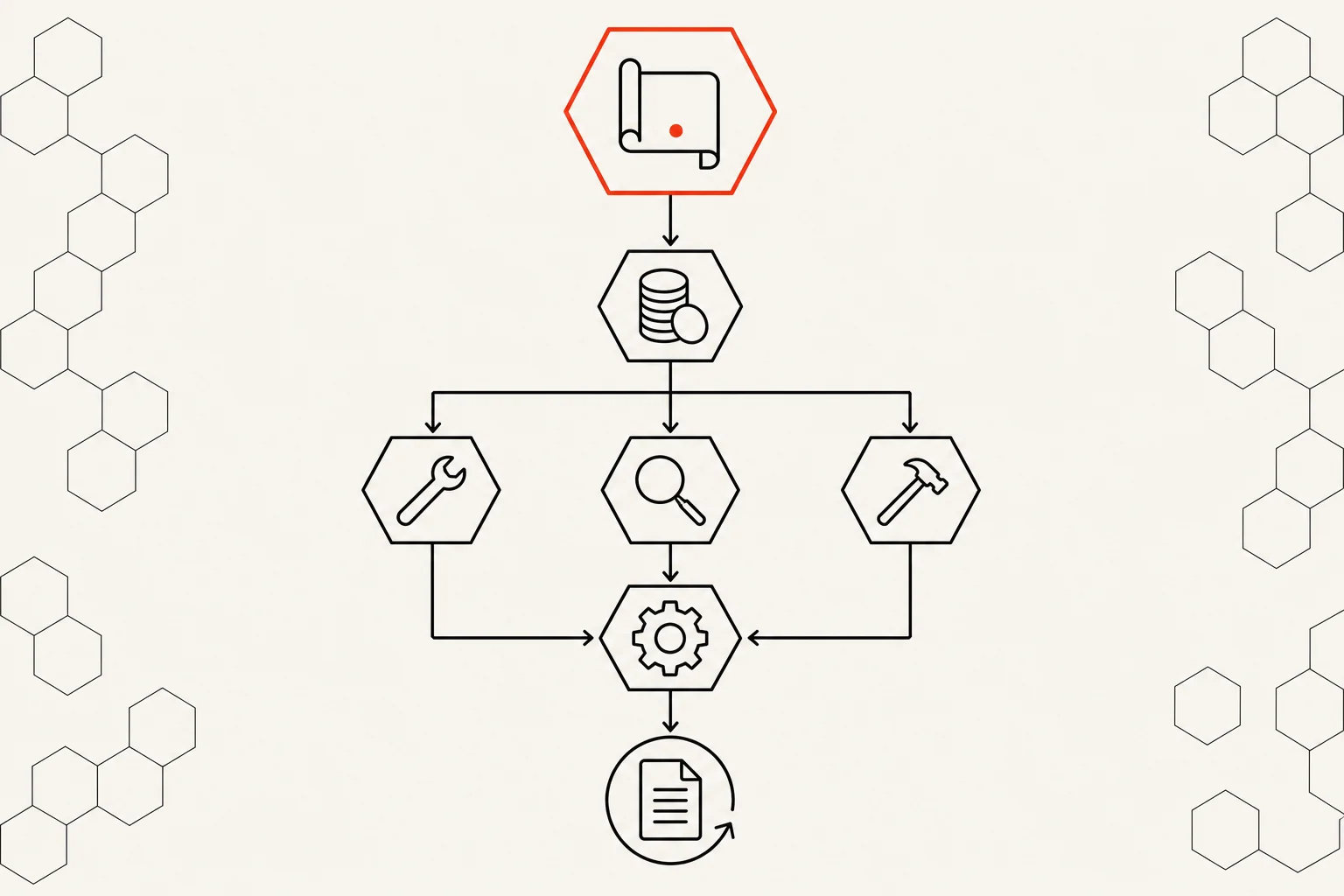
Indra is that picture as an operating system. The Queen plans, the Scribe allocates, specialist workers execute, a compiler returns the consolidated result, and every agent call is a transaction you can replay.
Plans are a small JSON DSL called BeeScript: a goal, a credit budget, a DAG of subtasks. Workers are designed to run as containers with a sidecar for RPC. A credit system turns compute and API charges into one fungible unit, so a swarm halts when the budget is gone instead of running until someone notices the bill. Malformed plans are patched or rejected before they spend anything.
This was the main research project at Five Labs, the studio I ran alongside my job at HCLTech. I wrote the whitepaper as sole author and published it in July 2025, then the public MVP (Queen, router, workers, compiler, tests) the same month.
method
The paper treats every RPC as a state transition with a fee, a trace, and an optional memory write, and it lays out an evaluation plan rather than results. What I actually tested was smaller: can a plan be validated before it spends, can independent tasks run in the right order, can a failed worker be retried without losing the graph. The MVP answers those with BeeScript, a router, and tests. It does not implement the full IVAM, Firecracker sandboxing, or the on-chain audit log the paper describes.
what I found
The design held technically. The unit economics did not hold as a business, and that is the result I trust more: a credit budget is a product feature, and it is also how you find out that the work costs more than the customer will pay.
Five Labs shut down on that finding. The whitepaper and the MVP are the record. Marshmallow is what I kept from the same question, pointed at memory instead of a whole colony.
open
Whether replayable multi-agent work can be made cheap enough to ship. Whether a person can read a BeeScript plan the way they can read a Marshmallow file. The paper is self-published and has not been submitted anywhere. The MVP has not been developed since July 2025.