fig. p-05 · enterprise service
the problem
After Slick I moved back home, and HCLTech was standing up a new GenAI division nearby. I wanted to see what building looks like inside a company of two hundred thousand people. The clients did not want a chatbot. They wanted a way to know whether an answer was true enough to ship.
what I did
The platform was LLM guardrailing and evaluation for enterprise deployments: truthfulness, relevancy, and safety scoring, a prompt lab, monitoring, and red-teaming exercises against client systems. I was the lead engineer. Three engineers worked with me; I trained them on building with language models, set their assignments, and reviewed what came back. It was the first role where I was responsible for other people's output as well as my own.
The other surprise was how much of the job happened outside the codebase. I pitched to prospective clients, walked leadership through demos, collected buy-in from business stakeholders, and taught prompt engineering to engineers with decades more shipping experience than me, which taught me as much as it taught them. The platform shipped to Fortune 500 clients; the names are under NDA.
method
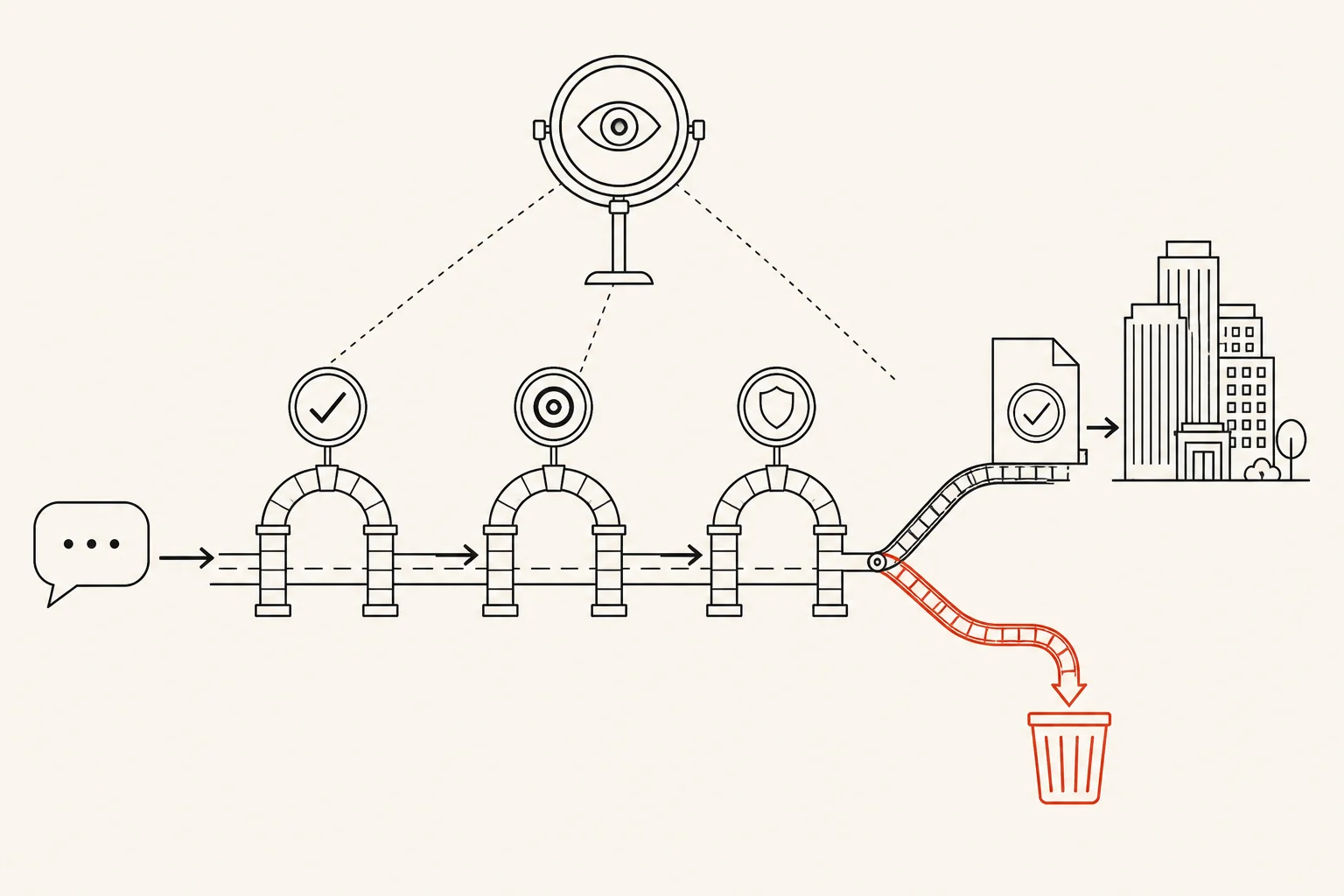
Truthfulness compared a model answer against a reference corpus and asked whether the claims were supported, not whether they sounded right. Relevancy scored whether the answer addressed the asked question or wandered. Safety was a policy screen. Red teaming worked the other direction: constructing the prompts and attack paths that make a guarded system fail, so the scores could be trusted under adversarial use.
None of those scores are client data, and I am not reprinting client dashboards. The architecture is the thing I can show: prompt in, three scores, a decision about whether the answer ships.
what I found
What enterprises buy is confidence in the system, built one careful demo at a time, and a guardrail the buyer cannot explain does not produce it. Evaluation, safety, and adversarial behaviour are where I built the expertise the later research work stands on.
open
I left in August 2025 to give the research questions the year had opened my full attention. What the enterprise work taught me still holds, and Marshmallow is the smaller, later version of the same demand: if a system is going to speak, you should be able to see why.